

中性原子量子计算
(Neutral Atom Quantum Computers)
科研骨干:许鹏、何晓东、李潇、付卓、汤彪
(Key Researchers:Xu Peng, He Xiao-Dong, Li Xiao, Fu Zhuo, Tang Biao)
As natural qubits free from manufacturing defects, neutral atoms boast excellent connectivity and scalability, making them an ideal system for controlled quantum simulation of many-body physics and quantum computing. We have developed a unique neutral-atom quantum computing and quantum simulation platform, structured with magic-intensity optical dipole traps confining heteronuclear (Rb-85, Rb-87) atomic arrays.
We have successfully developed Hanyuan-1 (汉原-1), the country’s first export-ready, cabinet-style cold-atom quantum computer. Powered by neutral-atom qubits, it features 100+ usable qubits with single-qubit fidelity >0.999 and two-qubit fidelity of 0.98, enabling multi-qubit entanglement and arbitrary qubit connectivity for both globally controlled quantum simulations and circuit-based quantum computing. Designed for practicality, it requires no cryogenics, fits in three standard racks, and consumes ~90% less energy than conventional systems, operating reliably in normal lab environments. Notably, it leverages a fully domestic supply chain—from lasers to control chips—freeing it from U.S. export restrictions. Integrated with a quantum cloud platform, it already serves 50+ universities and enterprises, marking a major milestone in scalable, application-ready quantum technology.
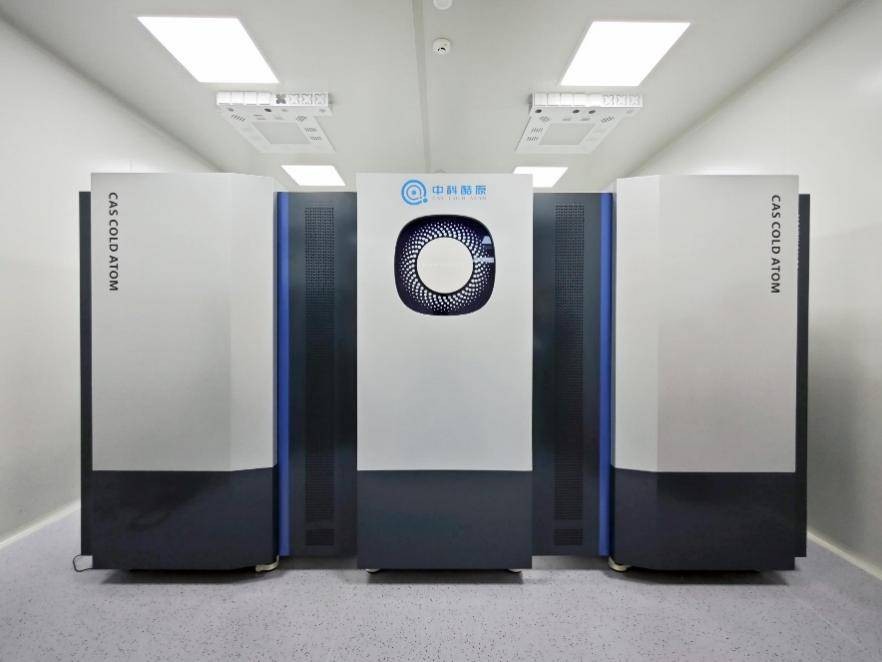
The first commercial atomic quantum computer delivered to a subsidiary of China Mobile
(A Fiber Array Architecture For Atom Quantum Computing)
Using a fiber array, we experimentally demonstrate the trapping and independent control of ten single atoms in two-dimensional optical tweezers, achieving individually addressed single-qubit gates with an average fidelity of 0.9966(3). More significantly, we perform simultaneous arbitrary single-qubit gates on four randomly selected qubits, resulting in an average fidelity of 0.9961(4)(Nat. Commun. 16: 9728, 2025).
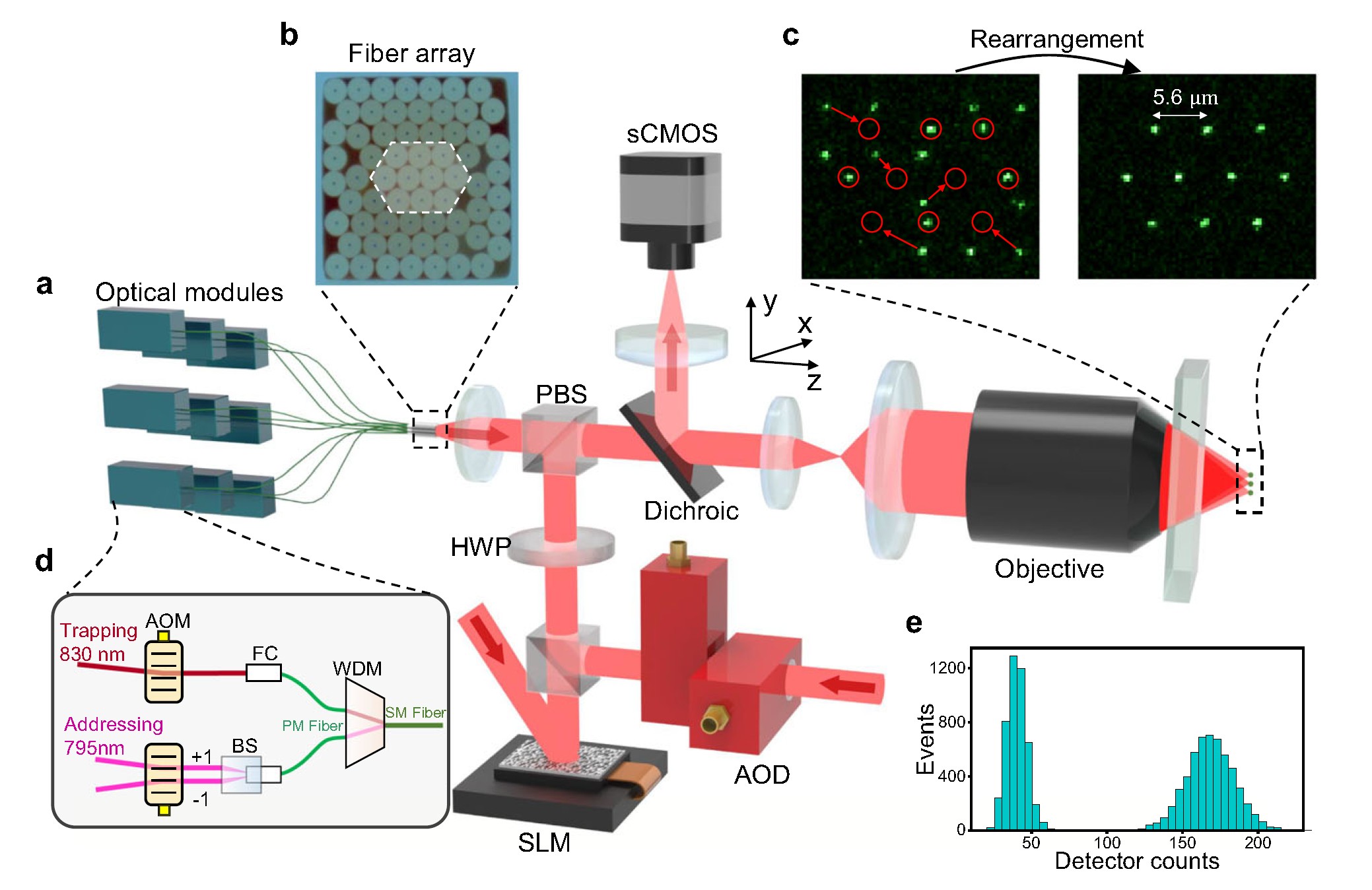
Experimental scheme. a Basic experimental setup for the trapping, rearrangement, manipulation, and detection of single-atomarrays. b The cross-section of the fiber array. c Single-shot fluorescence image of an atomarraywith 50ms exposure time. d A schematic showing optical setup in the optical module. e Histogram of collected photons for one of the fiber traps during the initial loading process.